The Window and the Frame: The Eye Story!
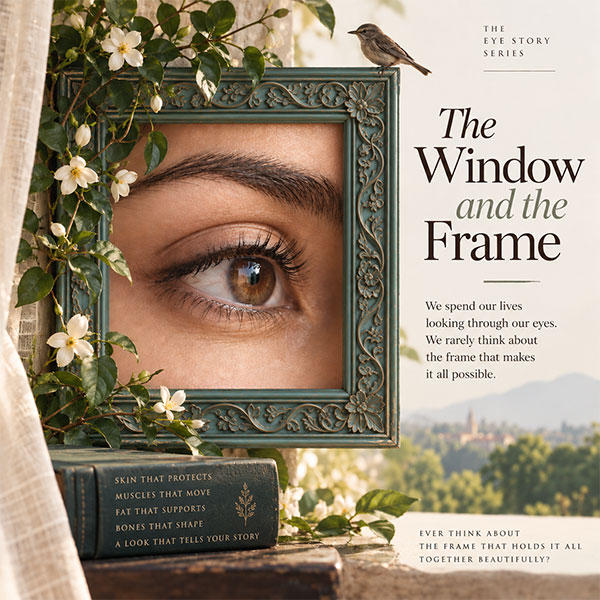
We spend our lives looking through our eyes. Perhaps we sometimes forget to notice the beautiful frame that makes it possible.
We look. At the morning sky, a familiar face across the table, a book held close, a child running across a room. There is always something ahead to look at, somewhere to go, something to see
And perhaps because we are so occupied with what lies beyond, we forget to notice the frame around the window. The frame holds the window in place. It protects it from the elements. It gives it shape and character. And sometimes, if we pause long enough to look, we realise that the frame itself is beautiful.
Our eyes have their own remarkable frame.
The eyelids may seem like nothing more than delicate folds of skin, but they are wonderfully designed. With every blink, they spread a thin layer of tears across the surface of the eye, keeping it smooth, clear and comfortable. They close to protect the eye from dust, wind and injury, and open again to let us see the world.
But the eyelid does not work alone. Beneath the skin are muscles that open and close the eyes, delicate tissues that support their movement, and fat that cushions and protects. Behind it all is the bony orbit, a protective socket that gives the eye its shelter and shape. Even the eyelashes have a purpose, helping to keep unwanted particles away.
Together, skin, muscle, fat and bone create something far more intricate than a frame.
And, then there is the beauty of it.
The curve of an eyelid. The crease above it. The sweep of the brow. The transition from the eye to the cheek. These small details are different in every face. They influence how we express ourselves, how awake or tired we appear, and, perhaps most importantly, how we recognise ourselves. It is only when something changes that we begin to notice.
An eyelid may become heavy. Skin may begin to rest differently. The eye may look smaller, more tired, or simply unfamiliar. Sometimes the change affects vision or comfort; sometimes it changes the way we feel when we look in the mirror.
This is where the work of an ophthalmic plastic surgeon becomes more than simply changing what is visible. It is about understanding what is beneath the skin, what the eye needs to function well, what has changed, and what the person hopes to see when they look at themselves.
Sometimes the frame needs to be repaired. Sometimes it needs to be reconstructed. And sometimes it can be gently rejuvenated.
But perhaps the most important question is not “How can we change the frame?”
It is:
“How can we care for it, safely and thoughtfully, while preserving what makes the view and the person looking through it; uniquely their own?”
Because we may spend our lives looking at what lies ahead. But every now and then, it is worth pausing to appreciate the beautiful frame that holds it all together.